
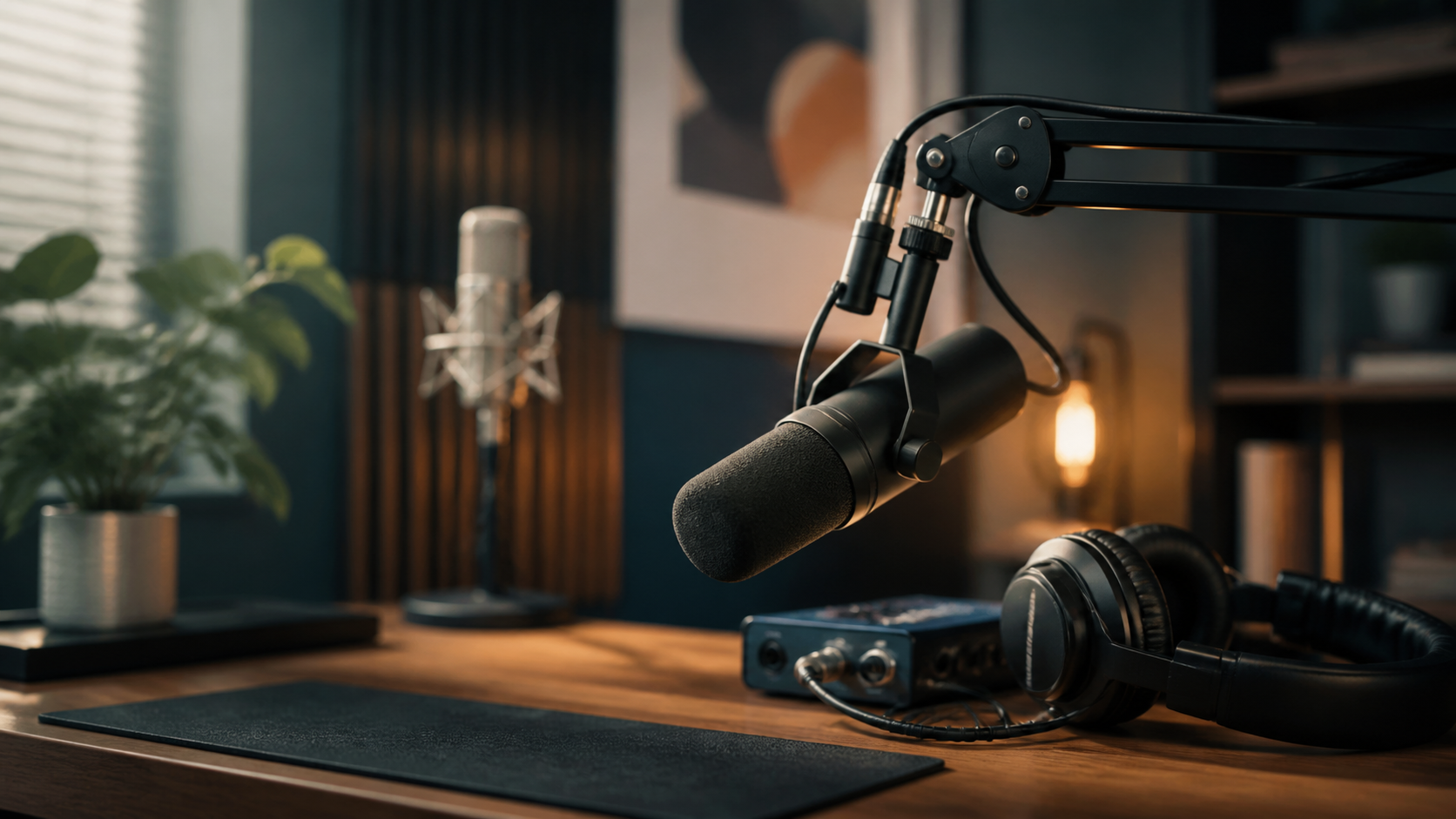
In an untreated room, a close directional dynamic microphone usually solves more audible problems than a costly sensitive condenser. Spend first on stable placement, monitoring, and the room; upgrade the microphone only when a controlled comparison exposes a specific limitation.
The microphone records the room too
A microphone cannot separate voice from reflections, HVAC, keyboard noise, or a computer fan after those sounds reach the capsule. First record thirty seconds at the intended position. Move noise sources, reduce hard parallel reflections, and place a directional microphone close enough to increase the voice-to-room ratio. This changes the captured signal; noise reduction only processes it afterward.
Dynamic versus condenser is a workflow decision
Dynamic microphones generally produce less electrical output and are often worked close, which can make them practical in untreated spaces. Condensers are usually more sensitive, require power, and can reveal quiet detail—but also room sound, mouth noise, and poor technique. Neither technology is automatically superior. The useful question is whether the source, room, placement, and preamp support it.
Price the complete path to the recording
A USB microphone may include conversion, gain, headphone monitoring, cable, and processing. An XLR microphone may also require an interface, XLR cable, stand, headphones, pop protection, and sometimes additional clean gain. Compare the cost of a working signal chain, not the microphone box. A lower-priced XLR microphone can become the more expensive first setup.
Specifications predict constraints—not taste
Polar pattern, sensitivity, self-noise, maximum SPL, power, connector, and weight help identify compatibility and operating limits. Frequency response does not tell you whether a voice will be flattering, and a 192 kHz converter does not rescue distant placement or an echoing room. Use specifications to reject mismatches, then use controlled recordings to choose sound.
Amazon affiliate disclosureAs an Amazon Associate I earn from qualifying purchases. Clearly identified Amazon product links in this guide are affiliate links. This does not affect the price you pay or the guide’s editorial conclusions.
Four useful shortlists—not eight interchangeable microphones
Start with the job and room that match yours. This guide covers stationary creator voice, podcast, voice-over, and home-studio recording; it does not evaluate wireless lavaliers, camera-mounted microphones, or multi-host field systems.
Samson Q2U
USB-C and XLR, zero-latency headphone monitoring, both cables, and basic mounting create a complete first recording path without blocking a future upgrade.
Skip it only if you already need multi-microphone recording or detailed instrument capture.RØDE PodMic USB or Shure MV7+
Both combine a close-address dynamic capsule with USB/XLR and monitoring. PodMic USB is the direct podcast choice; MV7+ earns its premium when automatic level and DSP matter.
Skip both if your existing interface already provides clean gain and you do not need USB features.RØDE NT1 5th Generation + PSA1+ bundle
USB/XLR, a load-rated boom arm, shock mount, pop filter, low documented self-noise, and high maximum SPL create a complete desk-based path for narration, vocals, and instruments.
Skip it when untreated-room reflections are already obvious in a phone recording—or when you already own suitable mounting and would be paying twice for it.SM7B, RE20, or TLM 103
Each solves a different professional constraint; none is a universal upgrade. Buy only after a controlled test exposes the limitation it addresses.
Skip the prestige purchase when mounting, gain, room, or technique remains the real bottleneck.What each microphone requires before it records
| Model | Type | Connection | Monitoring | What else | Room behavior |
|---|---|---|---|---|---|
| Samson Q2U | Dynamic | USB-C + XLR | Built in | Stand upgrade; headphones | Forgiving when close |
| SM58 | Dynamic | XLR only | Via interface | Interface, cable, stand | Forgiving when close |
| PodMic USB | Dynamic | USB + XLR | Built in | Load-rated stand | Forgiving when close |
| MV7+ | Dynamic | USB + XLR | Built in | Load-rated stand | Forgiving when close |
| NT1 5th Gen + PSA1+ | Condenser | USB-C + XLR | External | Boom included; quiet room | Revealing |
| SM7B | Dynamic | XLR only | Via interface | 60 dB gain; strong stand | Forgiving when close |
| RE20 | Dynamic | XLR only | Via interface | Clean gain; strong stand | Forgiving when close |
| TLM 103 | Condenser | XLR only | Via interface | 48 V, mount, controlled room | Highly revealing |
Build the cart before comparing prices
Samson Q2U · current price at checkout
IncludedUSB-C and XLR cables, mic clip, windscreen, desktop tripod, and tripod extension
AddWired headphones; preferably a stable boom or floor stand
Amazon prices and availability can change. Confirm the exact seller, package contents, return terms, and checkout total before buying.PodMic USB · microphone plus load-rated support
IncludedThe microphone supplies USB/XLR connections, monitoring, DSP, internal pop filtering, and internal shock mounting.
AddA boom or stand rated for its 900 g weight, plus wired headphones
Check current component prices at checkout. The USB path needs no interface.MV7+ · microphone plus load-rated support
IncludedThe microphone supplies USB/XLR connections, monitoring, Auto Level, denoising, digital pop filtering, and a USB-C cable.
AddA compatible boom or stand and wired headphones
Check current component prices at checkout. Use XLR only when a mixer, multi-microphone interface, or replaceable conversion becomes necessary.NT1 5th Gen + PSA1+ · current bundle price
IncludedThe linked Amazon bundle combines the black microphone, SM6 shock mount/pop filter, XLR and USB cables, and PSA1+ desk-mounted boom arm.
AddHeadphones and an adequately controlled room
Compare the live bundle total with the standalone components before checkout. USB avoids an interface; XLR operation requires a 48 V-capable interface.SM7B · microphone plus interface and support
IncludedThe microphone includes internal isolation and windscreens; the Scarlett Solo 4th Gen is a viable single-microphone interface candidate.
AddXLR cable, strong boom/stand, headphones, and confirmation of at least 60 dB of clean gain; add inline gain only if the interface test fails.
Check each current price at checkout. Do not compare the microphone price alone with a complete USB setup.RE20 · microphone plus interface and support
IncludedThe microphone includes internal pop filtering and element shock mounting; the Scarlett Solo 4th Gen is a viable single-microphone interface candidate.
AddXLR cable, strong stand, headphones, and confirmation of sufficient clean gain; optional suspension depends on vibration testing.
Check each current price at checkout. Total cost may rise with mounting or gain requirements.TLM 103 · microphone plus interface and room system
IncludedThe standard nickel package includes the microphone and wooden storage box; the Scarlett Solo 4th Gen can supply the required 48 V phantom power.
AddXLR cable, stand, pop protection, monitoring, suitable suspension if needed, and a controlled room
Check each current price at checkout. A high system total is not evidence that the result will suit a particular voice.Four starting positions that prevent bad purchases
End-address dynamic for speech
Start 5–10 cm from the grille, aimed toward the mouth but 20–30° off-axis.
Move farther off-axis for plosives; move closer for more voice relative to room, then lower gain to avoid clipping.Side-address condenser for narration
Face the marked front of the capsule, not the top. Start 15–20 cm away with a pop filter between mouth and microphone.
Increase distance for mouth noise or proximity buildup; reduce reflective surfaces behind and beside the speaker.Desk with keyboard or computer fan
Put the microphone between the noise and the mouth with its least-sensitive side aimed toward the noise.
Record while typing and rotate the microphone to find the lowest spill; do not rely on the cardioid label alone.Boom or floor transmission
Keep the arm, cable, and stand from touching vibrating equipment.
If tapping the desk appears in the recording, isolate the support or use a floor stand before buying another microphone.The detailed product profiles
Amazon—not Maker Signal—sets prices, availability, shipping, sellers, and checkout terms. Confirm the exact configuration and package contents before purchasing.
Samson Q2U
Check Amazon for the current price and availability. Amazon—not Maker Signal—sets the final price, shipping, and seller terms.
Amazon affiliate link- Works for
- First podcast, field interview, spoken tutorials, video calls, or a simple live/recording crossover.
- Why it may work
- Samson documents USB-C and XLR operation, zero-latency headphone monitoring, and a package with USB-C and XLR cables, desktop tripod, extension, mic clip, and windscreen.
- Why it may not
- The supplied desktop tripod can transmit desk impacts and may place the microphone too far from the speaker. Its 16-bit/48 kHz USB path is sufficient for speech but not a reason to choose it for specialized high-resolution production.
- Complete it with
- A stable boom or floor stand is the first useful upgrade; add closed-back headphones.
Shure SM58
Check Amazon for the current price and availability. Amazon—not Maker Signal—sets the final price, shipping, and seller terms.
Amazon affiliate link- Works for
- Live vocals, presentations, mobile interviews, and rugged spoken-word work.
- Why it may work
- The 50 Hz–15 kHz vocal response, spherical pop filter, shock mounting, steel grille, and directional pattern are purpose-built for close vocal use.
- Why it may not
- Computer recording requires an interface; its handheld shape and tailored response are less convenient than USB podcast designs for a fixed desk.
- Complete it with
- XLR cable, interface or recorder, stand/clip, and monitoring headphones.
RØDE PodMic USB
Check Amazon for the current price and availability. Amazon—not Maker Signal—sets the final price, shipping, and seller terms.
Amazon affiliate link- Works for
- Podcasting, streaming, gaming, and voice-over in less-than-perfect rooms.
- Why it may work
- USB includes a high-gain preamp, DSP, zero-latency monitoring, internal pop filter, and shock mount; RØDE specifies a 5–10 cm working distance.
- Why it may not
- At 900 g it demands a load-rated stand or boom; close technique remains necessary.
- Complete it with
- A sturdy boom arm or stand is essential; an external pop filter is optional rather than automatic.
Shure MV7+
Check Amazon for the current price and availability. Amazon—not Maker Signal—sets the final price, shipping, and seller terms.
Amazon affiliate link- Works for
- Solo creators who want USB simplicity now and XLR later.
- Why it may work
- Shure documents Auto Level, denoising, digital pop filtering, compression, limiting, high-pass filtering, and a 3.5 mm monitor output.
- Why it may not
- DSP convenience does not replace placement, and users who already own a capable interface may pay for duplicate electronics.
- Complete it with
- Load-rated boom/stand; supplied USB-C cable. XLR cable and interface only when using analog output.
RØDE NT1 5th Generation + PSA1+
This Amazon listing bundles the black NT1 5th Generation with the PSA1+ desk-mounted boom arm. Check Amazon for the current bundle price, seller, contents, and availability.
Amazon affiliate link- Works for
- A new desk-based setup for controlled-room vocals, voice-over, acoustic instruments, amps, and percussion.
- Why it may work
- RØDE specifies 4 dBA self-noise, 142 dB maximum SPL, and 32-bit-float USB output. The bundle combines the microphone’s SM6 shock mount, pop filter, XLR and USB cables with the PSA1+ boom arm for repeatable positioning.
- Why it may not
- Its sensitivity exposes room decay and noise, it has no built-in headphone output, and XLR operation requires 48 V phantom power. The bundle is poor value if you already own a suitable stand or boom.
- Complete it with
- Add monitoring headphones. USB operation needs no interface; XLR operation requires a 48 V-capable interface or mixer.
Shure SM7B
Check Amazon for the current price and availability. Amazon—not Maker Signal—sets the final price, shipping, and seller terms.
Amazon affiliate link- Works for
- Broadcast, podcast, close voice-over, studio vocals, and loud instruments.
- Why it may work
- Its 50 Hz–20 kHz response, electromagnetic hum shielding, internal air-suspension isolation, tone switches, and close-talk windscreen are documented.
- Why it may not
- At 1.12 mV/Pa it is low output. Shure specifies at least 60 dB of preamp gain for voice-over; confirm the interface can supply it cleanly.
- Complete it with
- Interface with sufficient clean gain, XLR cable, strong boom/stand, and headphones; an external shock mount is not normally required.
Electro-Voice RE20
Check Amazon for the current price and availability. Amazon—not Maker Signal—sets the final price, shipping, and seller terms.
Amazon affiliate link- Works for
- Broadcast speech, voice-over, podcasting, kick drum, guitar, and demanding location work.
- Why it may work
- Variable-D minimizes proximity effect, while the internal pop filter, shock mounting, humbucking coil, and 45 Hz–18 kHz response address close broadcast work.
- Why it may not
- Its 1.5 mV/Pa output and 737 g body demand adequate gain and support; it is unnecessary when a small USB dynamic already passes the recording test.
- Complete it with
- Interface/preamp, XLR cable, strong stand; EV lists the 309A suspension mount as optional.
Neumann TLM 103
This Amazon listing is the standard nickel TLM 103 package, not the Anniversary Edition or EA 1 Studio Set. Check the current price, seller, package contents, and availability before checkout.
Amazon affiliate link- Works for
- Controlled studios recording speech, vocals, piano, drums, amplifiers, and acoustic instruments.
- Why it may work
- Neumann specifies 7 dBA self-noise, 23 mV/Pa sensitivity, 138 dB maximum SPL, and a presence lift intended for direct definition. The standard package includes a wooden storage box.
- Why it may not
- High sensitivity and definition reveal reflections, sibilance, mouth noise, traffic, and weak performance. The fixed cardioid pattern may be less versatile than cheaper multi-pattern models, and this package does not include the EA 1 suspension mount.
- Complete it with
- 48 V interface/preamp, XLR cable, stable stand, pop filter, and—if vibration testing justifies it—a compatible suspension mount. Room control is part of the purchase.
Price cannot solve a mismatch
“A premium condenser captures more detail.”
True detail includes the room, clothing, mouth noise, and traffic. In an untreated office, that extra information can increase editing rather than quality.
“A famous broadcast microphone creates a radio voice.”
The SM7B and RE20 still require close placement, adequate clean gain, stable mounting, and performance technique. Their tone does not replace those conditions.
“Higher sample rate means better speech.”
Placement, clipping, room sound, and microphone/source fit dominate ordinary spoken-word results. Choose sample rate for the production workflow, not as a proxy for audible quality.
“The upgrade is the microphone.”
If a blind, level-matched recording cannot expose a repeatable limitation, the upgrade may be mounting, room treatment, monitoring, technique, or no purchase at all.
Buy only what fixes a demonstrated problem
Boom arm or stand
Necessary whenever correct distance cannot be held consistently.
RØDE specifies that the PSA1+ supports microphones and mounts from 94 g to 1.2 kg, clamps to desks up to 70 mm thick, and includes a 3/8-inch-to-5/8-inch adapter. Check the complete mounted weight and desk before buying. The linked NT1 bundle already includes a PSA1+, so those buyers do not need another.Check price on AmazonPop filter or windscreen
Necessary when plosives overload close speech; outdoor wind needs dedicated protection.
SM58, PodMic USB, SM7B, and RE20 include internal or supplied protection. Test before adding another layer.Shock mount
Useful when floor or desk vibration reaches the capsule.
The linked NT1 bundle includes the SM6 shock mount/pop filter; the SM7B has internal isolation; EV lists a suspension adapter for the RE20. Do not buy by habit.Audio interface
Required for an XLR microphone to reach a computer unless another recorder or mixer performs that job.
The Scarlett Solo 4th Gen provides one microphone preamp, 48 V phantom power, and headphone monitoring. It fits one-microphone setups, not two-host XLR recording. Check input count and clean gain—not sample rate alone.Check price on AmazonInline gain device
Conditional, not universal: useful when a low-output passive microphone and preamp cannot achieve a clean working level.
The Cloudlifter CL-1 provides up to +25 dB using 48 V without passing phantom power to the passive microphone. Test the interface first: buying one automatically for an SM7B or RE20 can add cost and another cable without improving a clean, adequately powered setup.Check price on AmazonBudget closed-back headphones
The Audio-Technica ATH-M20x is a lower-cost wired starting point for checking levels, noise, clipping, plosives, and latency.
It uses a closed-back design, 40 mm drivers, and a single-sided fixed cable. Choose it for affordable recording isolation—not because one headphone can prove a mix translates everywhere. It does not fold and its cable is not detachable.Check price on AmazonStep-up closed-back headphones
The Sony MDR-7506 is the more established foldable monitoring option when portability and long professional use matter.
Its wired closed-back design avoids Bluetooth latency and folds for storage. Use it to inspect the microphone path—not as proof that a mix will translate everywhere. Its fixed coiled cable and aging ear pads may be drawbacks for some users.Check price on AmazonRoom control
Necessary when reflections or external noise dominate the recording.
Absorption at reflection points and source-noise reduction matter more than decorative foam coverage.What we verified—and what we have not
VerifiedManufacturer documentation was checked for connection, power, included accessories, output or sensitivity, weight, published positioning guidance, and listed prices where available.
Not yet testedMaker Signal has not yet recorded a level-matched, same-room comparison of these eight microphones. No sound-quality ranking here is presented as a hands-on result.
Our publication standardWhen first-party recordings are complete, we will publish the room, interface, placement, gain, loudness-matching method, raw clips, and revision date.
Make the upgrade survive a blind listen
1Use the same room position for every microphone.
2Measure capsule distance and angle; document gain and processing.
3Match playback loudness before judging sound.
4Read 45 seconds containing quiet and loud speech, plosives, sibilants, numbers, and silence.
5Randomize filenames; score intelligibility, room sound, plosives, noise, tone, and editing time.
6Repeat the winner on another day. Buy only if the advantage survives.
Protect the decision
Buy from the manufacturer or an authorized seller when possible; preserve the listing and serial information.
Confirm the return window allows setup and repeat testing, and keep every insert and package until the decision is final.
Verify what the exact regional package includes; mounts, cables, windscreens, and cases vary by bundle.
Test at normal editing loudness and level-match alternatives. A louder sample can seem better even when it is not.
Export and replay the raw recording outside the microphone app before judging built-in processing.
Research behind this guide
Samson — Q2U Product and SpecificationsShure — SM58 Product SpecificationsRØDE — PodMic USB Product and SpecificationsShure — MV7+ User GuideRØDE — NT1 5th Generation SpecificationsShure — SM7B User GuideShure — SM7B Gain RequirementsElectro-Voice — RE20 SpecificationsNeumann — TLM 103 SpecificationsFocusrite — Scarlett Solo SpecificationsCloud Microphones — Cloudlifter CL-1RØDE — PSA1+ SpecificationsAudio-Technica — ATH-M20x SpecificationsSony — MDR-7506 Product SpecificationsHow we’ll keep this guide current
Material changes to the cited guidance, prices, availability, or commercial terms will trigger a review before this page is republished.