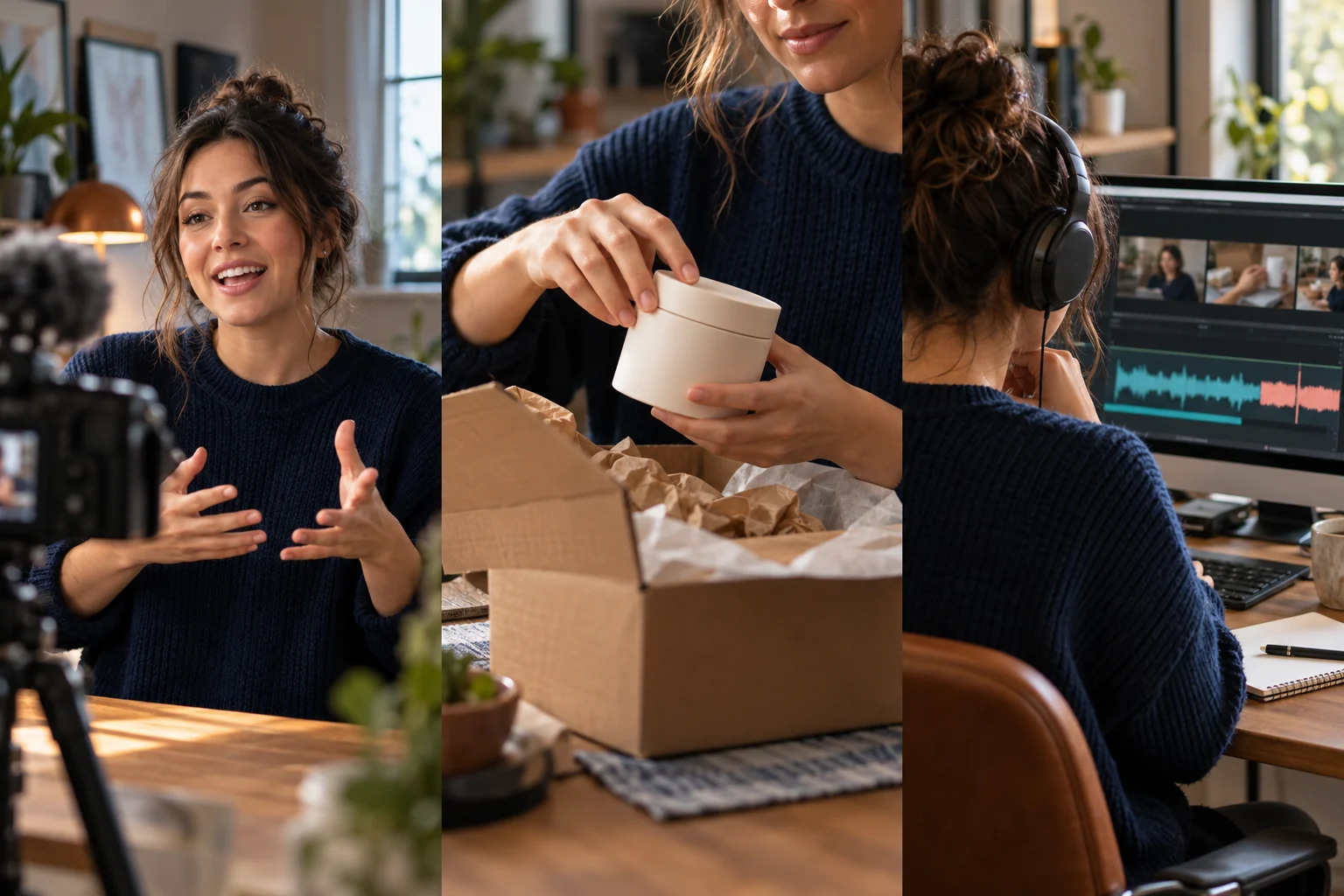
You do not need a large following to sell content-only UGC. You need proof that you can interpret a brief, show a product clearly, record clean audio or useful natural sound, edit to the requested format, and deliver on time. Build six honest spec samples with products you already own. Then accept product-only work only when the product has real value to you, the assignment is tightly scoped, and the agreement does not quietly include perpetual paid-ad rights.
First, know which business you are entering
“UGC” is used loosely. Ask which of these arrangements the brand actually wants before discussing compensation.
Content-only UGC
You make files; the brand posts them. Your follower count is not the product. Insense explicitly separates UGC with no posting required from social-posting campaigns.
Clarify: deliverables, edit/raw files, organic channels, paid ads, term, territory and revisions.
Creator post
You publish to your account. Now the brand is buying production plus access to your audience and reputation.
Clarify: platform, live period, disclosure, link, exclusivity and whether the brand may reuse the post.
Creator ad
The brand runs an ad through or connected to your account—such as a TikTok Spark Ad or Meta partnership ad. This is an added permission, not an automatic part of filming a video.
Clarify: authorization period, platforms, spend/territory limits, edit permission and renewal.
Product seeding
A brand sends product to prompt honest feedback, content, or a possible post. Insense labels this separately from traditional paid collaborations.
Clarify: whether content is guaranteed, whether posting is required, and what the brand may do with anything you submit.
Affiliate content
You may receive product and earn commission when tracked sales occur. Commission is uncertain; it should not be described as guaranteed pay.
Clarify: rate, attribution window, returns, payout threshold, permitted claims and content-use rights.
Influencer / ambassador work
Often combines recurring posts, category exclusivity, event attendance or community participation. A flattering title does not define the workload.
Clarify: total term, minimum output, cancellation, exclusivity and every compensation component.
Every practical way to create UGC
Choose a format that fits the product and your comfort level. “Faceless” is a production choice, not a lesser tier.
| Format | What appears | Best use | Proof your sample should show |
|---|---|---|---|
| Face-to-camera | You speak directly to camera | Problem/solution, founder-style, explanation | Natural delivery, eye line, clean audio, credible specificity |
| Face + demonstration | Your reaction plus product in use | Beauty, kitchen, tools, tech, apparel | Product visibility, continuity, honest experience |
| Hands-only | Hands and product, no face | Unboxing, assembly, texture, tutorials | Stable framing, readable details, clear sequence |
| POV | Viewer sees your perspective | Routine, travel, home, retail, apps | A coherent first-person journey and usable B-roll |
| Voice-over | Product/lifestyle footage under narration | Faceless education, comparisons, demos | Pacing, script clarity, audio control, matching visuals |
| Text-led / silent | On-screen copy plus footage | Sound-off placements, simple demos | Readable captions, visual hierarchy, safe-zone awareness |
| ASMR / natural sound | Close product sounds, little or no speech | Food, packaging, cleaning, craft, tactile goods | Clean sound capture and sensory detail |
| Screen recording | App or website walkthrough | SaaS, apps, digital products | No private data, legible steps, cursor/tap clarity |
| Stop motion / tabletop | Animated objects or arranged still life | Small products, packaging, launches | Lighting consistency and deliberate transitions |
| Photo UGC | Product-only, lifestyle, selfie or sequence | Web, email, social, product pages | Sharp focus, brand-safe styling, multiple crops |
| On-location | Store, restaurant, service or venue | Local businesses and experiences | Arrival, environment, service, result; permission where needed |
| Family / pet / multiple talent | Other recognizable people or animals | Household and lifestyle narratives | Written permissions, safety and a clear added-talent scope |
Common creative structures can sit on top of any format: unboxing, first impression, tutorial, three benefits, objection handling, routine integration, problem/solution, comparison, FAQ, “things I wish I knew,” product close-up montage, or testimonial. Use “before and after” only when it is truthful, representative, and allowed for the category.
Decide when product-only work is rational
A product is compensation when it is exchanged for work. Treat it like barter, not a favor. The IRS says the fair market value of goods or services received through bartering must generally be included in gross income; U.S. business-related barter income is generally reported on Schedule C.
real product value to you − out-of-pocket costs ≥ your minimum value for production time + rights granted
Value the product at what you would otherwise pay for it, not the brand's aspirational retail price. If you would not buy it, its practical value to you may be near zero. This is a decision tool, not a tax valuation method.
A defensible starter product-only offer
- One product you genuinely want and are qualified to use.
- One 15–30 second edited vertical video, or a small agreed photo set.
- One concept and one consolidated revision for factual or brief alignment.
- Brand-owned organic social use for a short, written term.
- Portfolio display permission after the brand launches the asset.
- No posting to your account, raw footage, paid ads, creator-ad authorization, category exclusivity, perpetual rights or transfer of copyright unless separately negotiated.
Decline or counter when
- You must buy first without a documented reimbursement path.
- The “payment” is only a discount.
- The product creates safety, medical, financial or reputational risk.
- The brief asks for claims you cannot honestly make.
- The product value is low but the shot list is large.
- Unlimited revisions are implied.
- Perpetual, worldwide, all-media rights are bundled.
- Raw footage or editable project files are included without discussion.
- You must post and provide ad authorization for product only.
- The brand refuses to identify the legal business or sign a scope.
Build the portfolio before waiting for free products
Use products you already own. Label the pieces “spec sample” or “self-initiated sample” so viewers do not infer a brand commissioned them. Insense's current UGC-only application guidance asks for 6–12 videos across at least two categories and two formats, including on-camera and voice-over examples. That is one platform's admission standard—not a universal industry rule—but it is a useful portfolio stress test.
A six-piece starter portfolio
- Face-to-camera problem/solution. 20–30 seconds; one real problem, one demonstrated feature, one honest conclusion.
- Hands-only demonstration. Show setup, three actions and the result without hiding cuts that change the outcome.
- Voice-over routine. Five to seven B-roll clips with narration that matches what is visible.
- Screen-recorded tutorial. Show a digital workflow using a demo account and no personal data.
- Text-led silent edit. Make the core idea understandable without audio; keep text away from interface zones.
- Product photography set. Hero, detail, in-use, scale/context and one alternate crop.
Use this 25-second sample structure
0–3 sec — Specific hook: “I kept losing the small pieces every time I packed this.” 3–8 sec — Show the friction: Two fast shots that make the problem visible. 8–18 sec — Demonstrate: Show the product solving the problem; name only features you verified. 18–23 sec — Honest result: Describe the observed result without a superlative. 23–25 sec — CTA option: Deliver one version with a brand-approved CTA and one clean ending if agreed.
Technical baseline
- Record the requested orientation; 9:16 is common for short-form, but the brief controls.
- Clean the lens, lock exposure/focus when practical, and record in soft, even light.
- Put the microphone close enough for speech to beat room noise; capture room tone and natural product sound.
- Hold product labels long enough to read; avoid mirrored labels and accidental competitor marks.
- Save clean masters without platform watermarks. Export captions separately or provide captioned and clean versions when scoped.
- Do not use trending music by default. TikTok recommends its Commercial Music Library for commercial posts; Meta says its general licensed library is intended for personal, non-commercial use and points commercial creators to Sound Collection.
Where the first legitimate work comes from
Direct outreach
Target small brands with active social accounts, a product you can genuinely use, and an observable creative gap. Reference one product and propose one concept. Verify the contact through the brand's official site.
Local businesses
Restaurants, studios, shops, services and venues need on-location footage. Pitch a specific deliverable, arrange filming permission, and avoid capturing customers or staff without consent.
UGC marketplaces
JoinBrands documents reimbursement, brand-shipped and digital-product jobs; it also distinguishes content-only from posting jobs. Insense separates product seeding, no-posting UGC, social posting and creator ads. Read each live brief and platform terms.
Agencies and production partners
Performance agencies often need repeatable batches and multiple hooks. Lead with reliability, format range and turnaround. Ask which entity signs, reviews and pays.
Creator marketplaces
Meta's creator marketplace is available in selected markets. TikTok One supports brand/creator collaboration. Eligibility can change; use the official in-app route rather than paying an unknown “manager.”
Warm network and inbound
Tell founders, freelancers and local operators exactly what you make. Publish spec samples and a clear contact method. A vague “open to collabs” post gives a buyer nothing to brief.
A pitch that is easy to answer
Subject: One short-form concept for [product] Hi [name] — I create [face-to-camera / hands-only / voice-over] product content for [category]. I noticed [specific, verifiable observation about the product or current content]. Concept: “[working hook].” I would show [three-shot sequence] and deliver one [length] vertical edit plus [agreed variant]. For a first collaboration, I am open to a product-only portfolio project if the scope is one concept, one consolidated revision, short-term organic brand-channel use, and portfolio permission. Paid ads, raw footage, posting, exclusivity and extended usage would be separate. Samples: [portfolio link] If useful, who handles creator briefs?
Track brand, official contact, product, concept, date sent, reply, scope, product value, cash/expenses, rights, deadline, status and next follow-up. Stop after a brief, professional follow-up; do not automate spam.
Put the deal in writing before the product ships
U.S. copyright generally begins with the creator when an original work is fixed. A qualifying work made for hire or a signed transfer can change ownership. Sending files does not by itself explain what the brand may do with them. Use a written agreement and seek qualified counsel for high-value or unusual rights.
| Term | Write down | Why it matters |
|---|---|---|
| Deliverables | Count, length, orientation, raw/edit, captions, hooks, photos | “One video” can otherwise become many assets. |
| Creative approval | Brief, mandatory claims, prohibited claims, review contact | You need a truthful script and one decision-maker. |
| Revisions | Included rounds, consolidated feedback, what counts as reshoot | A new concept is not a minor revision. |
| Compensation | Exact product/SKU, cash, shipping, tax, expenses, payment timing | “Gifted” does not settle out-of-pocket costs. |
| Organic license | Channels, territory, start date, term, edits allowed | Brand-owned social use is narrower than all media. |
| Paid media | Platform, term, territory, account, edit rights, renewal | Ad use increases exposure and should be explicit. |
| Creator authorization | Spark/partnership ad permission and exact duration | TikTok says brand tagging can include 60-day ad authorization by default; inspect the live setting. |
| Ownership | License or assignment; work-made-for-hire language if proposed | Ownership and permission are different things. |
| Likeness / talent | Who appears, where likeness may be used, release terms | Protects you and any additional person on camera. |
| Exclusivity | Named competitors, territory and dates | Broad category lockouts can block future work. |
| Portfolio | Whether and when you may display the work | A starter project has little portfolio value if it stays hidden. |
| Cancellation | What happens after shipping, scripting or filming begins | Allocates sunk time and nonreturnable costs. |
Disclosure is part of production
- FTC: free or discounted products are a material connection. Put a clear disclosure with the endorsement; do not bury it after “more” or among hashtags. The FTC says “Gifted by [Brand]” can be sufficient when the product is the only compensation.
- Instagram: Meta says gifted products count as an exchange of value and require the paid partnership label for branded content.
- TikTok: posts promoting a third-party brand for payment or another incentive must use the content disclosure setting; TikTok says improper disclosure may lead to removal or restriction.
- YouTube: creators must mark videos that include paid promotion or another commercial relationship. Platform tools do not replace any additional disclosure required by law.
- Content-only delivery: if the brand publishes the ad, put disclosure responsibility and final-claim approval in the agreement. Do not assume that handing off a file eliminates your exposure to false statements you recorded.
Run each job like a small production
- Qualify. Confirm brand identity, product, compensation, claims risk, deadline and intended use.
- Scope. Convert the brief into a written shot list, script outline, deliverables, revisions and rights.
- Receive and inspect. Film package condition if relevant; test the product long enough to speak truthfully.
- Approve claims. Ask the brand to confirm objective claims, pronunciations and mandatory language in writing.
- Film coverage. Capture hook options, wide/medium/detail shots, clean product shots, natural sound and extra handles.
- Edit safely. Use licensed assets, check labels and captions, remove private data and avoid unsupported transformations.
- Quality-control. Watch once muted, once with headphones and once on a phone. Check spelling, claims, safe zones, flashes, audio peaks, dimensions and file names.
- Submit privately. Use the agreed review channel, identify the version and request one consolidated feedback round.
- Archive evidence. Save the brief, agreement, approvals, source licenses, releases, final files and delivery record.
- Ask for the next step. After approval, request a short testimonial or permission to cite the deliverable—then offer a paid batch or defined rights extension.
A seven-day launch plan you can start today
Day 1 — Pick two lanes
Choose two product categories you already understand and two presentation modes: one human-led and one faceless. Write a one-sentence positioning statement.
Day 2 — Write six briefs
Use products you own. Define audience, problem, one verified feature, shot list, runtime and CTA. Avoid health or performance claims you cannot substantiate.
Days 3–4 — Shoot
Batch by lighting and location. Capture clean vertical masters, stills and natural sound. Keep all original files.
Day 5 — Edit and audit
Finish six varied samples. Remove watermarks and unlicensed music. Label them as self-initiated samples.
Day 6 — Publish the portfolio
Use a simple, mobile-readable page. Add contact details, services, region and rights boundaries. Test every video and link.
Day 7 — Send ten qualified pitches
Five direct brand pitches, three local businesses and two verified platforms or agencies. Each pitch gets one real observation and one concept.
Your first 30-day scorecard
Track inputs and quality, not promises: samples completed; qualified pitches sent; reply and brief rates; accepted projects; hours per deliverable; out-of-pocket cost; product value to you; revision count; rights granted; on-time delivery; testimonial/portfolio permission; and whether the next offer includes cash. Ten gifted jobs with vague rights are not automatically better than two tightly scoped projects that lead to repeat work.
Questions beginners should settle early
Do I need followers?
Not for content-only UGC. Posting, affiliate and creator-ad campaigns may require an eligible account or specific audience. Keep production and distribution as separate line items.
Should I call myself an influencer?
Only if audience distribution is part of what you sell. “UGC creator,” “product content creator,” or a specialty such as “hands-only beauty demo creator” may describe content-only work more precisely.
Can I use brand logos in a spec portfolio?
You can truthfully show a product you own, but do not imply sponsorship. Label spec work clearly, avoid modifying trademarks, and remove it if a rights issue arises.
Must I say positive things because the product was free?
No. Your statements should reflect your real experience. If the product does not support the planned claim, pause and tell the brand rather than recording a false endorsement.
What if the brand asks for “full rights”?
Ask them to define channels, paid/organic use, territory, term, editing, sublicensing and ownership. “Full rights” is not a precise production instruction.
Primary sources and verification notes
Official sourceRules and platform features can change. These pages were checked October 14, 2026. Marketplace statements describe their own systems, not the entire UGC market.
- FTC — Disclosures 101 for Social Media InfluencersMaterial connections, free products and clear placement of disclosures.
- FTC — Endorsement Guides: What People Are AskingGifted-product wording, honest experience, affiliate disclosure and brand responsibility.
- IRS — Topic No. 420, Bartering IncomeFair market value and general U.S. reporting treatment for business barter.
- U.S. Copyright Office — What Is Copyright?Initial ownership, fixation, licensing and transfer basics.
- U.S. Copyright Office — Circular 30: Works Made for HireThe limited statutory framework for work-made-for-hire status.
- TikTok — Promoting a brand, product, or serviceContent disclosure setting, brand tags and ad authorization.
- TikTok — Commercial use of musicCommercial Music Library recommendation and licensing warning.
- Instagram — What is considered branded contentGifted products as an exchange of value and paid partnership label requirement.
- Instagram — Access to the licensed music libraryPersonal/non-commercial library limits and Sound Collection.
- YouTube — Branded-content restrictions and disclosure labelsPaid-promotion declaration requirement.
- Insense — The types of campaignsProduct seeding, content-only UGC, posting and creator-ad distinctions.
- Insense — UGC-only creator applicationCurrent portfolio requirements and no-posting eligibility path.
- JoinBrands — Creator job typesReimbursement, brand-shipped and digital-product mechanics.
- JoinBrands — How it works for creatorsContent-only, posting and platform workflow.
- FTC — Bogus brand ambassador managersIdentity-theft warning signs and direct brand verification.
Update policy
Last reviewed October 14, 2026. Recheck disclosure tools, ad-authorization defaults, music licensing, marketplace onboarding, tax rules and any proposed agreement before relying on them. Maker Signal does not accept payment for placement.